
Big Soup
Welcome to Gourmet magazine, an independently owned digital food magazine that’s not affiliated with the Gourmet magazines of yore. Our Thursday editions are where we feature a great new recipe. Tuesday is for features.
IN THIS ISSUE: All the pretty Sietsemas, a reader correction, and saying it with beans.
Appetizers
Twisted Sytsma
Anyone could confuse them: a trio of writers whose job experience over three decades runs the gamut of food publications both shuttered and extant, and whose names are oddly similar. Allow us to disietsemambiguate.
Tom Sietsema: Recently left the Washington Post (RIP??) after 25 years as its anonymous food critic, probably just in time to avoid being laid off; an unnamed DC-based Friend of Gourmet (FrOG) reports that he “does seem to be the happiest person in Washington now that he is ‘out’ as it were, he seems to constantly be going to or hosting cool dinners and doing all kinds of fun special things now that people know who he is!” Wrote for Gourmet magazine (no relation to our Gourmet) at least once in the ’00s. Distant relative of Robert.
Robert Sietsema: New York-based cheap eats legend formerly of the Village Voice (RIP) and Eater, currently posting on Substack and working on a memoir. Wrote extensively for Gourmet magazine (no relation to our Gourmet) throughout the ’00s. Distant relative of Tom. [Disclosure: This author has dined with Robert on restaurant review quests in the past and would happily do so again.]
Alan Sytsma: Grub Street editor at New York magazine. Manned the phones, wrote stories, and performed other editorial assistant duties at Gourmet magazine (no relation to our Gourmet) in the late ’00s until its shuttering, then jumped to Food Network magazine before landing at Grub in 2010. Appeared as a guest judge on several episodes of Top Chef Masters. No known relation of Robert or Tom. [Disclosure: Alan edited Sam’s recent piece in Grub Street.]
We leave the task of counting how many James Beard awards and nominations the trio shares among them as an exercise for the reader. All S(iet|yt)s(e)mas, including ones not mentioned here, are welcome in the pages of our Gourmet (no relation to Condé Nast’s Gourmet magazine). —N.S.
A Communal Correction
In our item on Tuesday about the time that Chinese President Xi Jinping’s father, Xi Zhongxun, had a hearty German-Iowan meal at the Amana Colonies (which may have influenced Chinese agricultural policy in the 1980s), we wrote that the German religious commune decided to split up into private family farms in the 1930s.
A reader named Margo Jarosz wrote in with a correction:
Your reference to the Chinese delegation visiting the Amana Colonies some years back made me smile. I’m a direct descendant of those hardworking German immigrants. In 1932, when the decision was made to separate church and state, the community elders kept the farm holdings intact. The land, barns, livestock, equipment, etc. all became part of the Amana Society Corporation. Individuals were issued shares in the new for-profit entity. Amana Society Inc., continues to this very day, and the farm holdings are its largest assets.
Margo filled in a few more details, noting that a combination of encroaching modernity, a devastating fire, and the Great Depression’s effect on grain prices brought about the “Great Change.” Afterwards, Amana “became like any other small town,” where instead of being required to work for food, people were free to work for the corporation or anywhere else. “The Amana Church is still around,” she said, “but attendance ceased being mandatory.”
Thanks Margo! Eagle-eyed readers may have noticed that she shares a last name with Zach Jarosz, our Malört manufacturing source a few issues back. Margo is Zach’s mom. —S.D.

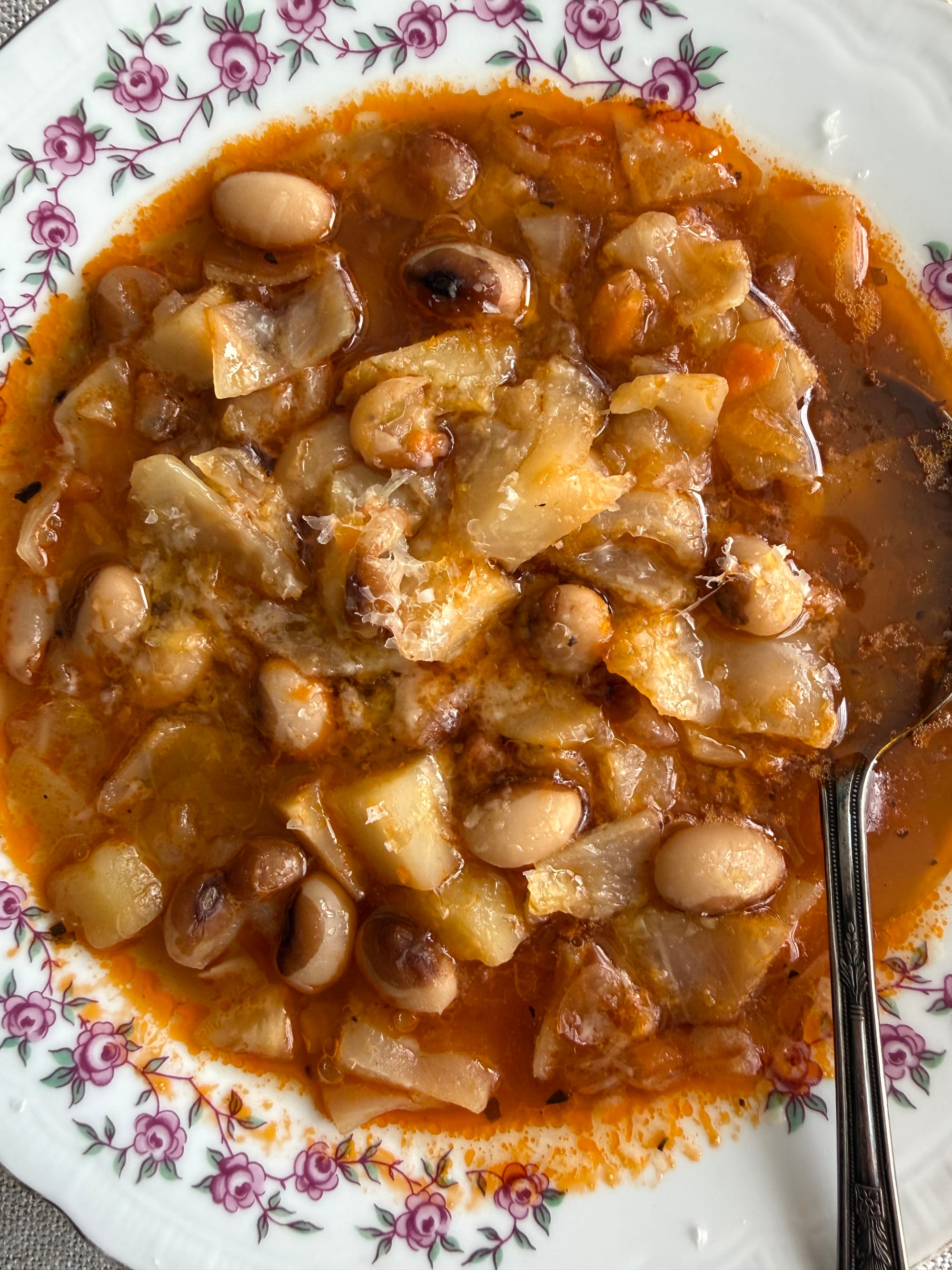
Big Soup
By Amiel Stanek
A (vegetarian) recipe for having them over.
For as long as my wife and I have been together, having people over for dinner has been our primary mode of socializing. This was true in our 20s, living in Brooklyn, where friends were always relieved to gather around a table without a bill at the end. It became even more true when we moved to a small town in the Hudson Valley, where Third Spaces are fewer and farther between. Now that we have two small children whose bedtimes precede civilized adult dinnertime, it is more or less the only way that we can hang out.
We have people over at least a few nights each week. These are the friends we don’t have to vacuum for, who are down to relax with a cocktail and a few olives, perhaps while holding a baby or reading to a toddler, and don’t mind when we disappear for a half hour to put the kids down. Then we can emerge blinking from darkened rooms, finish cooking, and enjoy a few hours of convivial togetherness.
This should not be misunderstood to mean that we are throwing “dinner parties” multiple times a week. We are simply cooking dinner for ourselves, which we were going to do anyway. And we’re making enough to share, be that with guests or our future selves, which we were also going to do anyway because cooking exactly enough food for two adults is awkward and difficult while cooking at a certain scale is efficient and humane.
So we make the food. And if people want to come over, great, and if they don’t we will still have dinner and some lunches or a quart of soup for the freezer or to bring to someone who needs it. Good leftovers make for good living.