

Absolute Units
Welcome to Gourmet magazine, an independently owned digital food magazine that's not affiliated with the Gourmet magazines of yore. Our Tuesday editions are where we feature great writing about food. Thursday is for recipes.
IN THIS ISSUE: Xi Jinping goes to Iowa (HLNY!) and a reader’s cornbread recipe.
Appetizers
新年快乐!
The year of the fire horse is upon us! Please write in with details (and photos!) of your favorite recipes and new year’s feasts, and we’ll share a selection in our Thursday newsletter.
(And if you happen to be in Los Angeles, you can grab a celebratory lunch from the chef and FrOG [Friend of Gourmet] Jess Wang at this event, where she’s serving food under her Gu Grocery banner alongside Senses beverages and the print-only Synonym Magazine.)
In this time of simmering geopolitical tension between the U.S. and China, I thought it might be interesting to check in on the menu at a particular Lunar New Year event: the luncheon thrown by the Chicago Chinese consulate in Muscatine, Iowa, where Chinese president Xi Jinping spent three memorable days with a local family during an agricultural delegation in 1985.
I got in touch with a man who attended the luncheon named Kenneth Quinn, who served as U.S. Ambassador to Cambodia for a stretch, spent a career as a Foreign Service Officer, and co-founded of the Des Moines-based World Food Prize Foundation alongside the food scientist Norman Borlaug (“father of the Green Revolution”).
Quinn said he had met Xi a few times on the Chinese president’s visits to Iowa, but a remarkable story Quinn told me was that he had met Xi’s father, then the governor of China’s Guangdong province, on a delegation through the state five years before his son visited. On this trip, Quinn took the group to the Amana Colonies, a collection of seven villages outside Cedar Rapids founded by religiously communist German immigrants in the 1850s. Over a meal of ham, schnitzel, and brats, Xi the elder peppered the Amana tour guide with questions about how the agricultural commune managed to split up its landholdings into family farms in the 1930s without dissolving the broader sense of community among the villages. Four years later, the Chinese Communist Party rolled out land reforms that split up communal farms into family holdings across the nation, after which farm productivity soared.
After some additional discussions of Yuan Longping, the revered Chinese scientist behind hybrid rice, plus the story of Borlaug throwing out the first pitch at a Red Sox game in 2004 and thereby breaking the Curse of the Bambino (“Because he was the Babe Ruth of feeding the world”), we arrived at the topic of the menu in Muscatine last Saturday. It turns out it was a bust: the consulate didn’t bring their own chef, so it was local food only. Quinn recalled cold mashed potatoes. “Fortunately,” he said, “I had brought some pastries from La Mie back in Des Moines.” —S.D.
Letter to the Editor
A subscriber named Lynne Cohen wrote in with a story and a recipe. We wanted to share:
Back when the world was still flat, I perfected a cornbread recipe. I was so sure it was that fabulous that I named it LA’S BEST OF ALL POSSIBLE CORNBREADS [Editor’s Note: after her initials at the time, Lynne Auerbach] and sent it to Gourmet for the From Our Readers column. I didn’t hear back, and while I didn’t exactly forget about it, I wasn’t exactly expecting anything, either.
A few months later, I came home from a shit week at work and sat down with my brand-new issue of Gourmet. Imagine my surprise to see a recipe for cornbread, credited as Cornbread Cohen. I was stunned. I was stunned because I had only been a Cohen for a couple of months, and didn’t realize until a minute or two later (as I read the recipe) that it was, indeed, my Best of All Possible Cornbreads.
Because I’m now of an age where one does not indulge in such extravagant riches, I haven’t made it in years. It is attached, with my compliments, because somewhere on my permanent record, it is noted that I had a recipe published in Gourmet Magazine. This makes me an award winning chef, right?
I tried the recipe out this past weekend, swapping the sour cream for some full-fat Greek yogurt I had in the fridge (purely for convenience), and have been happily munching on this savory, cheesy cornbread for days.
The Best of All Possible Cornbreads
- 1¼ cup cornmeal
- ¾ cup unbleached flour
- 1 tbsp baking powder
- 1/2 tsp baking soda
- 1 tsp salt
- 2 tsp honey
- 2 eggs, lightly beaten
- 1/4 cup (1/2 stick) unsalted butter, softened
- 4 oz grated cheddar cheese
- 3/4 cup milk
- 1/2 cup sour cream
- 1 cup fresh corn kernels
Combine the first five ingredients. Beat together the wet ingredients (except the corn and the cheese). Now add the corn and the cheese, then add the dry ingredients to the wet. Mix well. Bake in a lightly greased 8x13 inch baking dish at 400 degrees for 30 minutes or until golden and a toothpick inserted comes out clean.
—S.D.

Absolute Units
By Alex Tatusian
What the hell does “scant” mean? We ask the brains over at the National Institute of Standards and Technology for some help finding out
The question has lingered in the back of my head for years, but after reading about a cook who encountered a recipe calling for “scant egg whites,” I finally reached my wits’ end. How much less is a little less?
In other words: what the hell does “scant” even mean?
When a recipe (supposedly a manual against failure) instructs me (a person with generalized anxiety disorder) to use just a little less of an ingredient, what am I supposed to do with that? Why would a recipe writer do me—cut, burned, and in a flop sweat ahead of my dinner guests’ arrival—so dirty?
How much flour is in a scant cup of flour? Why does this recipe produce “a scant pint of ice cream,” just a little less than any human being would expect to find in an ice cream container? What would happen if I used a full tablespoon of pomegranate molasses, and not a scant one?
I’m far from the only cook who beefs with this prevarication. Even in a revised edition of The Joy of Cooking, Irma Rombauer and Marion Rombauer Becker discipline equivocal measurers with the austerity of great dominatrices:
All our recipes, in turn, are based on level measurements, hedgers like “heaping” or “scant” having been weeded out of our instructions years ago. Until you are experienced, we strongly urge you to make a fetish of the level standard measure.
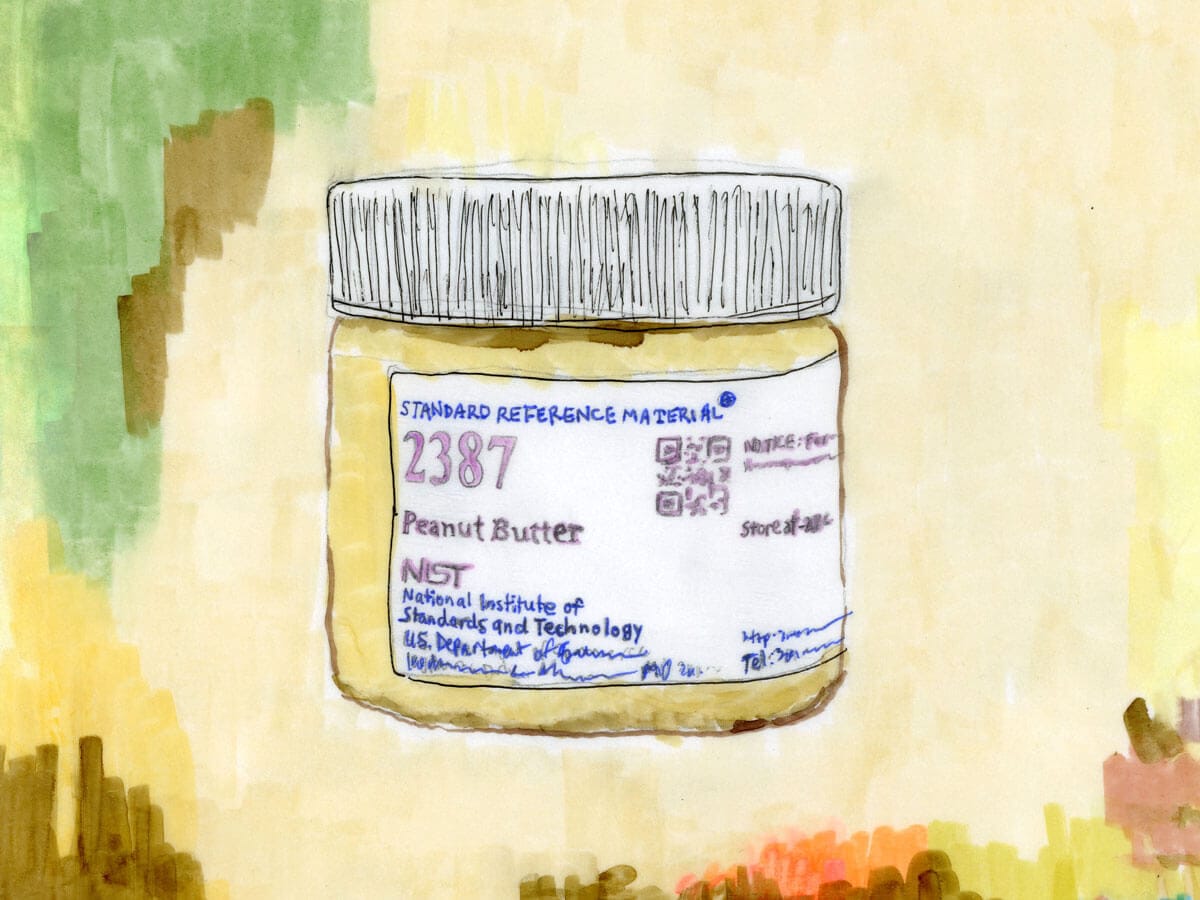
To get some answers, fellow Gourmet worker-owner Nozlee Samadzadeh recommended I reach out to the National Institute for Standards and Technology (NIST), an agency of the U.S. Department of Commerce. Among many other functions, NIST is the keeper of our national measurement standards—e.g. the scientifically-impeccable, laser-guided, lab-tested versions of units like the meter, the kilogram, the second, and the ampere, though they also produce benchmarks for tangible items like meat homogenate, cigarettes, and cranberry (fruit).