

Maximalism and Simplicity Combined
Welcome to Gourmet magazine, an independently owned digital food magazine that’s not affiliated with the Gourmet magazines of yore. Our Thursday editions are where we feature a great new recipe. Tuesday is for features.
IN THIS ISSUE: Encore plus du fromage trop cher, the less-picky kids of yore, and Alex goes bananas.
Appetizers
Milkin’ It
On Tuesday, I wrote of being shocked that a cheeky puck of Boursin Garlic and Fine Herbs Spreadable Gourmet Cheese was considerably more expensive per-pound than many, much finer fromages. Brian R. shared my dismay, and chimed in via email to say:
If you think Boursin is bad, avert your eyes from Babybel. At my Ralphs in South Los Angeles, a 6-pack (4.2 oz) is a whopping $5.99, or $1.42/oz, or $22.72/lb—for what I would argue is far lower quality than Boursin. My kids asked for Babybels for their lunches during our last shopping trip (“But Luciana brings them every day!!”), and it was the easiest No I’ve ever given them.
Thank you, Brian, for uncovering yet another glaring instance of French flimflammery! (And for compelling me to look at the Babybel Wikipedia page, where I learned that Le Groupe Bel, like many of my favorite chardonnays, hails from the Jura region of France.) From one parent to another: stay strong. —A.B.S.
Grown Appétit
Historian Helen Zoe Veit’s lovely book Picky: How American Children Became the Fussiest Eaters in History, released back in February, contains a constellation of fascinating facts on that theme. One data point popped: while sketchy research, changing nutritional standards, processed foods, and kid-targeted packaging certainly contributed to kids’ increasingly picky eating, Gourmet was interested to learn that kids used to be less fussy, especially before the mid-20th century, because they were coming to the table much hungrier. Children were expected to help out around the house and farm, milking cows, shoveling snow, and doing physically challenging chores. They were commonly walking miles a day, to school and back at the very least, if not to the grocery store, dairy, or butcher. So they worked up an appetite; they ate what was put in front of them, what grown-ups ate. They “loved spicy relishes, vinegary pickles, and bitter greens. They spent their allowances on raw oysters and looked forward to their daily coffee.” —A.T.
Banana Re: Public
From an undisclosed location on a small Hawaiian island—where I’m briefly staying with some local friends, for what it’s worth—I have been going bananas. Happy little bunches of bananas lopped off of a nearby apple banana tree hang from a beam on the porch here. Every day, I pluck one banana off. Then another. They’re delicious in a way that modern fruit rarely is, with a tang and a distinct caramel sweetness that puts one in mind of an acidified flambé.
The island food economy here flies in the face of what one would expect on the mainland (people here sometimes refer to the continental U.S. as “the States”). Someone who runs a local food hub, something between an online farmers’ market and CSA, where anyone with fruit trees can list whatever’s ripe that day, tells me that outsiders can’t even buy fish on the island, despite the fact that it’s everywhere, because people only sell what they catch to people they know. The omnipresent cultivation and preservation of the apple banana—a “canoe plant” brought in by early Polynesian settlers—persists in defiant contrast to Hawaii’s troubled history with Dole, the plantation economy, and the proliferation of the highly durable Cavendish banana. You know the Cavendish from the States. It’s likely the only banana you’ve ever tasted.
In trying to describe the apple banana, I thought about…well, you. Specifically about the trust you place in us at Gourmet. Taste is an impossible thing to write about. There is no real parity between palates, and esters aside—it’s the particularly subtle concentration of isoamyl acetate (the “Banana Ester”) that makes the Cavendish especially banana-y—you have no real clue what the hell is going on in my mouth. I don’t have to try to explain it to you. But for some reason I want to. Why should you believe me? Does it matter if you do? Yet here you are. Thank god for magazines. —A.T.

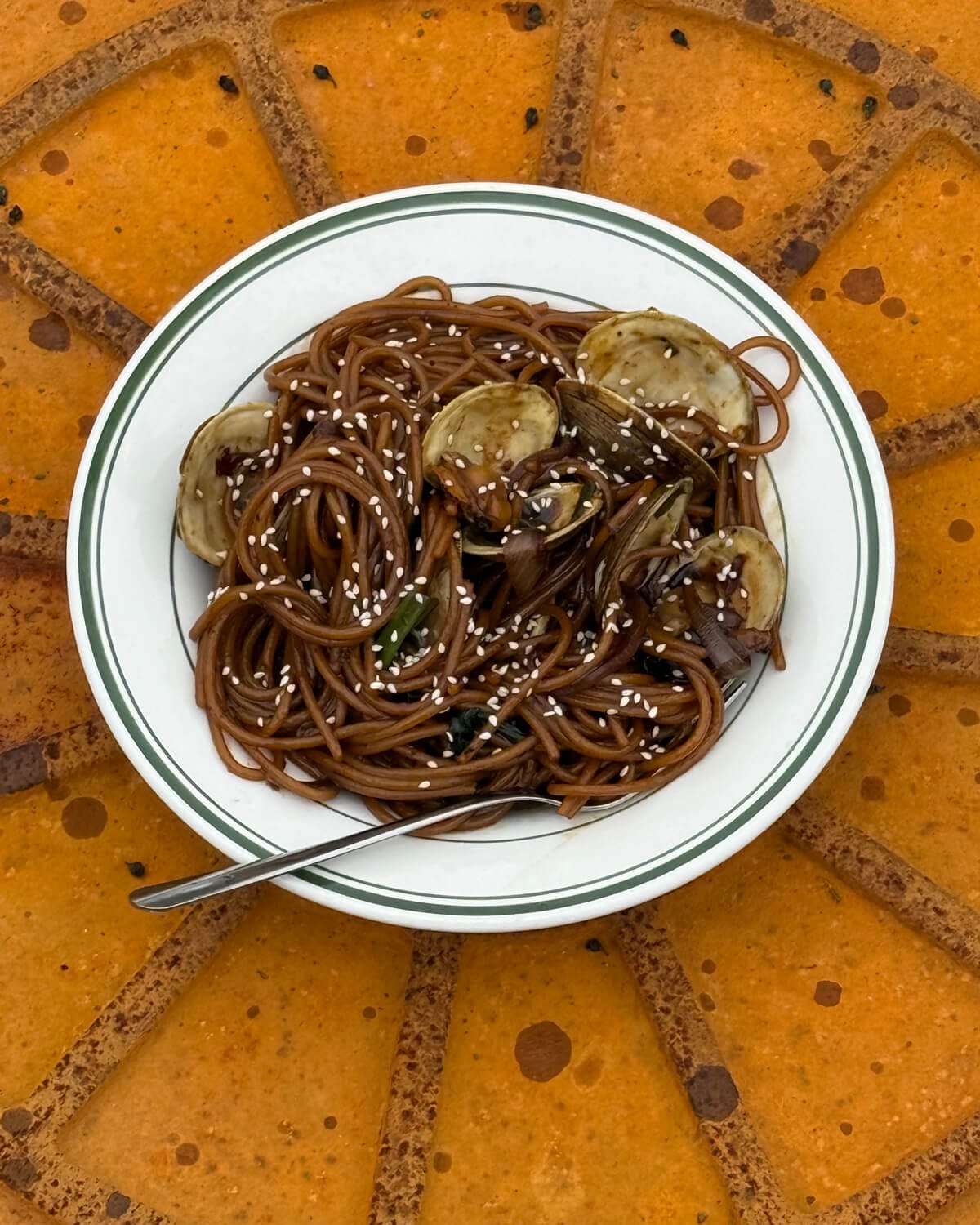
Maximalism and Simplicity Combined
By Doris Lam
A taste of Hong Kong in Italy, and the other way around.
Hong Kong isn’t known for its spaghetti, but to dismiss it entirely when you’re eating at a cha chaan teng would be a mistake.