

Making Lettuces Less
Welcome to Gourmet magazine, an independently owned digital food magazine that’s not affiliated with the Gourmet magazines of yore. Our Thursday editions are where we feature a great new recipe. Tuesday is for features.
IN THIS ISSUE: Sam experiences the joys of Alpine wine and Alex celebrates a very special kitab’s birthday.
Appetizers
Chasse du Chasselas

Descending from the French Alps towards Lake Geneva last week, we directed our rented Ford Focus toward Domaine du Buis, a small winery overlooking the sweep of the lacustrine valley. Raphaël Pariat, who took over operations from his dad in 2019, met us in his plywood tasting room for healthy pours of three vintages, drinking along as we wobbled between bad French and bad English. The wines were made from his four hectares (about ten acres) of Chasselas, the preferred grape on the shores of Lac Léman and more famous for their Swiss grand crus than their production in the Haute-Savoie. All three were exceedingly good on a hot morning, but especially Le Précieux from 2022, aged in steel: ripe quince on the nose, the color and translucency of strained lemon juice, and a fruity, salty tang on the tongue.
Pariat insisted we try a local specialty for hot days called simply “la chèvre”: a plastic beer cup filled with lightly fermented grape juice foam that he pulled from a tap and commanded us to chug. When he saw me eyeing his 1970s moped—a gas-powered Motobécane Motoconfort Mobylette in robin’s egg blue—he also insisted that I give it a spin around the rocky dirt roads of the vineyard. I survived, gleefully. —Sam
ذكرى سنوية سعيدة
A very happy 800th anniversary to Kitāb al-Ṭabīḫ (The Book of Dishes), one of the oldest known and most influential Medieval Arab cookbooks extant! For centuries, the comprehensive compilation by Muḥammad bin al-Ḥasan bin Muḥammad bin al-Karīm al-Baghdādī (often simply called al-Baghdadi) informed cooking in Arabic-speaking Asia and proved a favorite of the Turks and their eventual Ottoman Empire. Published at the end of the Abbasid era, a high point during the high-flying Islamic Golden Age, the book treats the enjoyment of food as “a princely activity devoted to the refinement of pleasure,” as Claudia Roden once put it. “The ‘plain dishes,’” in other words, “are not at all plain.” To borrow from al-Baghdadi, “praised be God, the creator of days, and appointer of times, the resurrector of mankind, the cause of foods” that we have writer Charles Perry’s 2005 translation of the text in Petits Propos Culinaires, my favorite food journal. We are reminded, 800 years later, to keep our fingernails trim in the kitchen to avoid injury and grime, that it is absolutely not forbidden in the Quran to “be meticulous about food,” and that al-Baghdadi prefers food above all other pleasures “such as clothing, drink, sex, and sound.” I’ll be attempting the recipe for Zaitūn Mubakhkhar—olives smoked by burning garlic, thyme, walnut, and sesame oil—soon, inshallah. —Alex

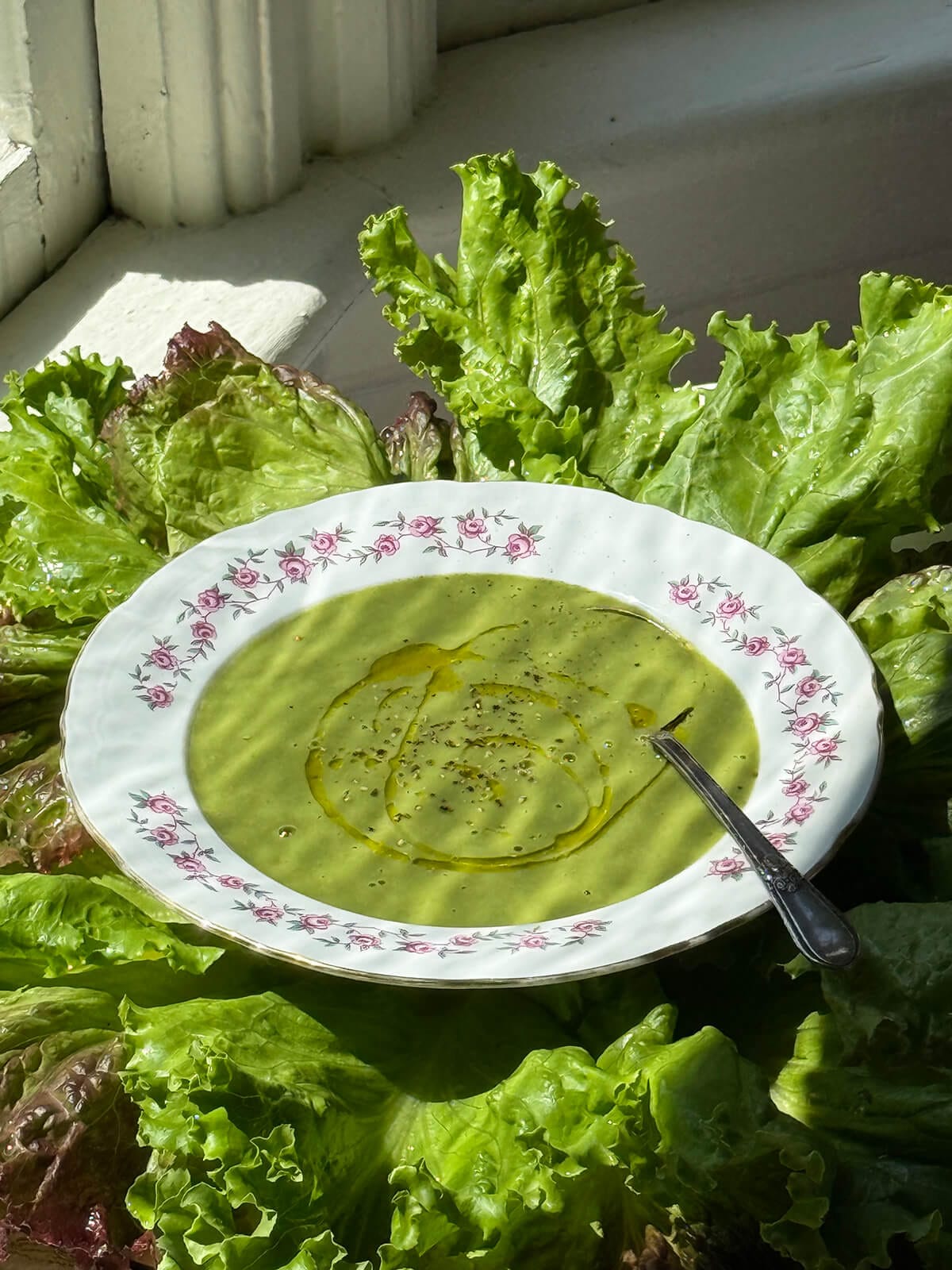
Making Lettuces Less
Recipe by Patch Troffer, text by Amiel Stanek
A salad soup for a leafy green glut
I myself have been thinking about cooking lettuce lately for reasons that, blessedly, have nothing to do with fecal-borne parasites and everything to do with practicality. The CSA we joined this year gives us entirely too much food: produce galore. To be clear, this is thrilling to me. I’m most inspired in the kitchen when there is a glut of something. Too much of any perishable ingredient creates urgency, a reason to scheme and strategize and plan. I lie awake at night thinking about what we’re going to do with the turnips, sit too long at green lights considering various ways all those radish tops could take up less fridge space. Ohitashi? Pesto? Namul? Great fun.